

History Remixed Through Visual Metaphor
December 17, 2015
One of the final scenes in the Roy Andersson film, A Pigeon Sat On A Branch Reflecting on Existence (2014), uses visual metaphor to collapse history into a sharp context that criticizes business, colonialism, and callous indifference. The film, the last in a trilogy, in Andersson’s words — on “what it’s like to be human” (Dagliden 2014), repeatedly explores the concept of how we treat each other. It is filmed in a series of vignettes, with a style that has come to be associated with his films: an anchored camera, a very deep depth of field, and a concept he calls light without mercy. He elaborates, “there are no shadows to hide in. You are illuminated all the time. It makes you naked, the human beings — naked” (Ulaby 2015). Andersson is very vocal about his influences and they span many different mediums from literature, to photography, to painting. He writes, “I realized that I had to leave realism, and find something else, and I found what I call ‘abstractionism’, inspired by that period in painting history that is not realistic” (Andersson 2015). As Ursula Lindqvist observed in her investigation of the correspondences between Andersson and eminent Peruvian poet Cesar Vallejo, Andersson’s work is concerned with the dynamics of domination, separation, and alienation in modern society (206). It is with this backdrop of formally honed visual aesthetics and predominantly humanist themes that the film follows two unsuccessful novelty salesmen as they look for prospective customers and attempt to collect on old debts.
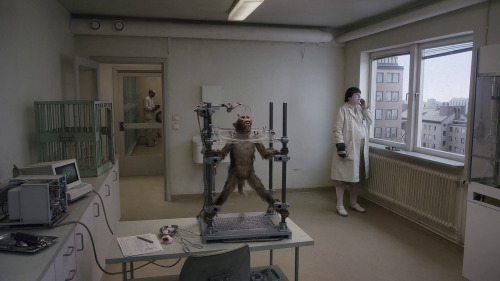
Fig 1. The laboratory worker and the chimp.
It is important to explain that the plot of the film does not follow the typical arc of most narratives. A Pigeon Sat On a Branch is more a collection of stand alone stories which at times spill into each other, while at others, are related only by their themes and subject matter. If one did not look closely, one might miss the overly touchy dance instructor and her student, from an earlier scene, in an argument, through a window, in the background of an otherwise unrelated scene about a man who’s misplaced his dinner reservation. Small interdependencies like this are hidden throughout the film, and would not be possible without the deep depth of field that Andersson employs. Another scene in which the two novelty salesmen are attempting to collect on a debt, and which ends with the store owner pulling a blanket over his head and shouting “I have no money!”, is thematically linked to the following scene where a child with down syndrome recites a poem in front of parents and students, about a pigeon who is resting and reflecting “on the fact that it had no money.” These shorter and more comedic earlier scenes, while making pointed critiques of capitalism in isolation, also serve as the foundation and philosophical primer for the more drawn out and serious scenes toward the end of the film.
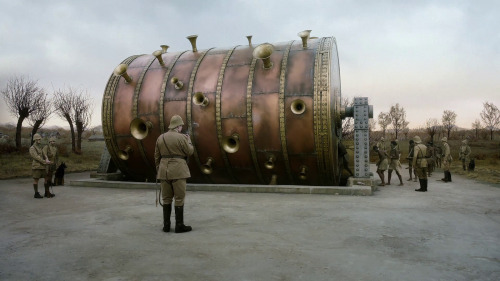
Fig 2. The British colonial soldiers and the African slaves.
One of these longer scenes, and the subject of this study, begins with a chain gang of African slaves being prodded by British soldiers into a very large circular drum, suspended in air on an axle (fig. 2). The iron drum is laden with horns that are scattered around its exterior. A british soldier locks the door to the drum, lights a torch, and sets flame to the pit beneath it. As the drum heats, in a long and drawn out scene which forces the viewer to reflect on the nature of the device, it slowly begins to spin, emitting a series of deep and ominous tones. In the only real direct sequential cut of the film, a technique rarely seen in Andersson’s work (Hanich, 40), we are spun around to face a sliding glass window (a motif I will explore further) directly opposite the previous shot (fig. 3), where the reflection of the flames, the drum, and the soldiers are clearly visible. As the glass slides open, a recurrent theme of ‘Veiling and Exposing’ in Andersson’s work (Hanich 46), the reflections give way to a procession of old, wealthy, white spectators. As they are ushered out onto a set of marble steps, they listen to the ‘music’ and watch the burning drum, while Jonathon, the meek novelty salesman from previous scenes, is seen pouring champagne into the glasses of the onlookers.
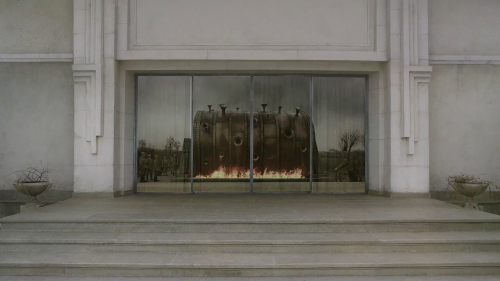
Fig 3. The viewer watches the drum in the reflection of the windows.
A full examination of this scene should not be considered without mentioning Julian Hanich’s excellent formalist analysis of Andersson’s work, Complex Staging: The Hidden Dimensions of Roy Andersson’s Aesthetics. In a planimetric shot, the camera stands perpendicular to a rear surface, and the image looks like people in a police lineup (Bordwell 2007), but as Hanich explains Andersson ‘never reverts to pure instances of the planimetric style’ (39), and this scene is no exception. The drum and the soldiers are canted in a slightly off angle, subverting the planimetric style, while the position of the onlookers in the following cut much more closely adheres to this shot type. The frontal staging of the onlookers creates an accusatory sense directed toward the viewer, where we were previously watching the drum in the reflection, we now become the source of the onlookers gaze (fig. 4). This motif of looking through windows recurs constantly throughout the film, but the most relevant instance in relation occurs in the preceding scene, where a lab worker stands talking on a phone and gazing out of a window ignoring the cries of a chimp who is repeatedly shocked with electricity (fig. 1). The juxtaposition between these two scenes creates a very real sense of guilt in the viewer, reminiscent of the lines from the post World War 2 documentary, Night and Fog (1955), which laments the events in Nazi concentration camps while simultaneously posing difficult questions of the audience:
“Who is on the look-out from this strange watch-tower
To warn us of our new executioners’ arrival?
Are their faces really different from ours?” (Resnais 1955)
Andersson has been a vocal advocate for the revival of a socially-conscious filmmaking (Lindqvist 216), and the presence of humanist ideals in his films has been a persistent theme throughout his canon. Unfolding the metaphor behind the giant drum, which has a somewhat historically collaged or sampled origin, can help to illuminate the outspoken nature of his otherwise veiled references. As the drum is turning the letters BOLIDEN are seen embossed in copper across the side. Boliden, a Swedish mining company that shipped approximately 20,000 tonnes of arsenic laden smelter sludge to an impoverished region of Chile in the mid 80’s, resulting in 700 Chilean victims suffering from arsenic poisoning (Sveriges Radio), is portrayed in this scene as the manufacturer of torture chambers. At the same time, British soldiers and African slaves from a colonial era are displayed across from the bourgeois relics of a more modern society. This collage style of metaphor, incorporating at once three different eras, serves to “collapse ‘real-time’ and history to illustrate that historical events continue to dwell in the present” (Lindqvist 218). In Songs From the Second Floor, Andersson uses this same technique to riff on a news report of South Koreans who rushed out to flagellate themselves in response to the Asian stock market crash of 1990 (Lindqvist 206). Again, we see it in the longest, and most breathtaking scene of A Pigeon Sat On a Branch, in which an 18th century Swedish cavalry rides into a modern diner while a marching band proceeds down the paved streets playing a song which borrows its melody from Glory, Hallelujah, an old folk hymn from the 19th century southern United States. This method of combining historical periods that share common threads of humanity aid Andersson in constructing visual metaphors that force viewers to reflect and feel a deeper sense of connection to a shared human history.
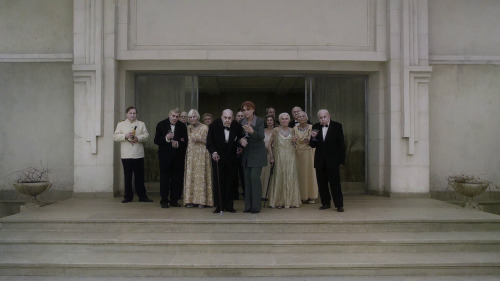
Fig 4. The onlookers and Jonathon facing the viewer in a planimetric shot.
“Is it right using people only for your own pleasure?” asks Jonathon, distraught after experiencing the drum scene as a quasi-dream sequence that he is struggling to make sense of. I imagine Roy Andersson to have a persistent empathetic complex, where the darkest parts of history hang always over his head. Where he is, like Jonathon, astounded that “nobody has asked for forgiveness.” It is inextricably linked to the idea that to avoid condemning the ‘other’ and repeating the horrors of history, one must accept even the harshest atrocities of our past, illuminated, without mercy.
Works Cited
A Pigeon Sat On A Branch Reflecting On Existence. Dir. Roy Andersson. Roy Andersson Filmproduktion AB, 2014.
Bordwell, David. “Shot-consciousness.” Observations on Film Art. N.p., 16 Jan. 2007. Web. 03 Nov. 2015.
Dagliden, Jonna. “Roy Andersson: ‘I’m Trying to Show What It’s like to Be Human’.” The Guardian. N.p., 28 Aug. 2014. Web.
Hanich, Julian. “Complex Staging: The Hidden Dimensions of Roy Andersson’s Aesthetics.” Movie — A Journal of Film Criticism 5 (2014): 37-50. Web.
Lindqvist U. Roy Andersson’s Cinematic Poetry and The Specter of César Vallejo. Scandinavian-Canadian Studies / Etudes scandinaves au Canada. 2010;19(Special issue on Nordic cinema):200-229.
Night and Fog. Dir. Alain Resnais. Argos Films, 1955.
Roy Andersson on A Pigeon Sat on a Branch Reflecting on Existence. Dir. Vpro Cinema. Perf. Roy Andersson. YouTube. YouTube, 24 June 2015. Web. 03 Nov. 2015.
“Swedish Mining Company Sued for Poisoning in Chile — Radio Sweden.” Swedish Mining Company Sued for Poisoning in Chile. SVERIGES RADIO, 16 Sept. 2013. Web. 03 Nov. 2015.
Ulaby, Neda. “Roy Andersson: From Mordant Ad Director To Philosophical Filmmaker.” NPR. NPR, 06 June 2015. Web. 03 Nov. 2015.