

Henry Miller and The Big Sur
July 31, 2014
Being new to California I wanted to read a book about its history. I read On the Road by Kerouac, but realized I don’t like him. Not his writing, that he’s got going for him, but the way that he is. He’s a fly on the wall. Listening to him talk about other characters, the famous Kerouac line:
‘The only people for me are the mad ones, the ones who are mad to live, mad to talk, mad to be saved, desirous of everything at the same time, the ones that never yawn or say a commonplace thing, but burn, burn, burn like fabulous yellow roman candles exploding like spiders across the stars and in the middle you see the blue centerlight pop and everybody goes “Awww!” ’
It comes off as disingenuous, because Kerouac never practices this. He expects it only of others, and that’s what he does — he follows his leader: Dean Moriarty. He kicks up his feet, and waits for the light show to start.
So when it came to the topic of Big Sur, I had a choice — between Kerouac’s Big Sur and Henry Miller’s Big Sur and The Oranges of Heironymous Bosch.
Henry Miller’s book caught my attention because earlier in the year I had learned about Heironymous Bosch through a rabbit hole that started with the concept of a Triptych.
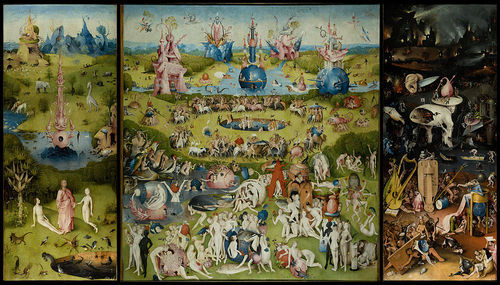
The Garden of Earthly Delights, a Triptych by Heironymous Bosch
This interested me not only because Bosch is an amazing artist, but also because of the format of a Triptych, in which a large center piece is typically accompanied by two smaller but related pieces. My friend Catherine, who actually suggested Henry Miller to me in the first place, mentioned his Rosy Crucifixion trilogy: Sexus, Plexus, and Nexus. One larger book, surrounded by two smaller books.

Sexus, Plexus, and Nexus by Henry Miller
It amazed me that an author could take inspiration from a painting format and apply it to writing. It made me think about all sorts of different variations on that theme. Was there a series of films in the form of a Triptych? Surely there was, I just must not have discovered them yet. Probably something Linklater would make.
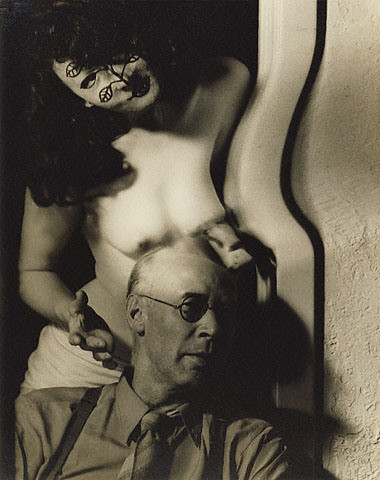
“First person, uncensored, formless — fuck everything!” — Miller on Tropic of Cancer
Henry Miller had a reputation for writing things which would inevitably be banned for obscenity in the United States and Great Britain. He continued to write obscene books and made a modest living from doing so, but his work wasn’t accepted in the United States, at least legally, until 1961.
But Miller’s Big Sur isn’t obscene. In fact it isn’t all that exciting. Big Sur smells like old leather boots and looks like an Escher painted in trees, neighbors and chores. And that’s all right, I’d even venture to say that’s the point. Because all that transpires between the covers is an exercise in beginning to ‘see with new eyes.’
‘Stay put and watch the world go round!’
Miller’s ability to convey the pure but bounded energy of the characters that inhabit Big Sur is inspiring. The way he manages to encompass a whole persons being in a few paragraphs without demeaning their character is an art in itself. He dedicates pages and pages to friends and family members, one chapter entirely dedicated to the children of his neighbors, and how they play and interact with his own children. He speaks of immigrants and the American dream. Of living simply, being an artist, and living the good life.
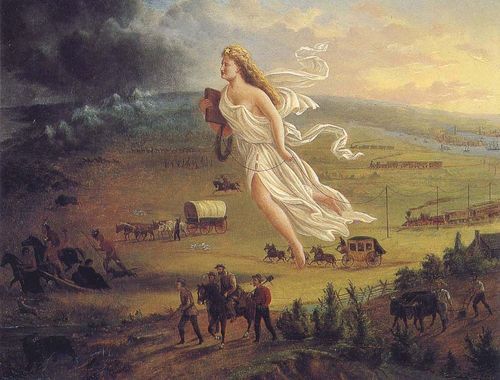
American Progress by John Gast
Miller’s American dream is different than what the concept of the American dream has become.
…nobody belongs who’s trying to simplify his life. Nobody belongs who isn’t trying to make money, or trying to make money make money. Nobody belongs who wears the same suit of clothes year in and year out, who doesn’t shave, who doesn’t believe in sending his children to school to be miseducated, who doesn’t join up with the Church, Grange and Party, who doesn’t serve “Murder, Death and Blight, Inc.” Nobody belongs who doesn’t read Time, Life, and one of the Digests. Nobody belongs who doesn’t vote, carry insurance, live on the instalment plan, pile up debts, keep a check account and deal with the Safeway stores or the Great Atlantic and Pacific Tea Company. Nobody belongs who doesn’t read the current best sellers and help support the paid pimps who dump them on the market. Nobody belongs who is fool enough to believe that he is entitled to write, paint, sculpt or compose music according to the dictates of his own heart and conscience. Or who wants to be nothing more than an artist, an artist from tip to toe.
This excerpt is from Chapter 15, and the entire chapter from start to finish, is 20 pages of Miller dancing around the ineffable. The 15th chapter alone is enough reason to buy the book, but this excerpt illustrates something important about American life. The difficulty in changing your lifestyle, in living outside of the culturally defined boxes meant to lead us to ‘success’, whatever that may mean, as it is a mystery to all but those who have designed the boxes in the first place.
Living in the culture of San Francisco and Silicon Valley and Startups and Techies and Investors and Marketing and Media and Hype, I think about the simple life often. For a period of time I might say that the concept of the simple life haunted me. I felt as though life was a balancing act, and I was doing an awful job at prioritizing the true necessities, the things which I was never taught, but that I knew were more important than tags and markup and design patterns and recursion, all of these skills that amounted to more investment in screen time and more eventual isolation from the real stuff out there.
Wherever we go, we must go naked and alone. We must each of us learn what no other can teach us. We must do the ridiculous in order to touch the sublime.
It’s dawned on me recently that my thoughts sometimes drown out my experience. That prioritizing and calculating often leads me to ignore what is right in front of me.
When do we begin to know that we know? When we have ceased to believe that we can ever know. Truth comes with surrender. And it’s wordless.
A great sense of stillness has come over me since reading Big Sur and the Oranges, it was somewhat of a nudge. I’ve began to realize that nothing is ever lost that wasn’t taken in the first place, and what can be, really? That to miss I’d have to be invested in the shot and to be invested in the shot would surely ruin my chances of experiencing it, hit, or miss. I’ve started a garden here in Berkeley, the squirrels are a nuisance but I’ve got a few peppers and some cacti to take root. There is art in everything, I’m positive of this. Cooking, walking with flip flops, eating oatmeal and brewing tea. Even coding, with its strict set of rules, can have the charm of a zen temple, doors open to the east.
Whoever uses the spirit that is in him creatively is an artist. To make living itself an art, that is the goal.